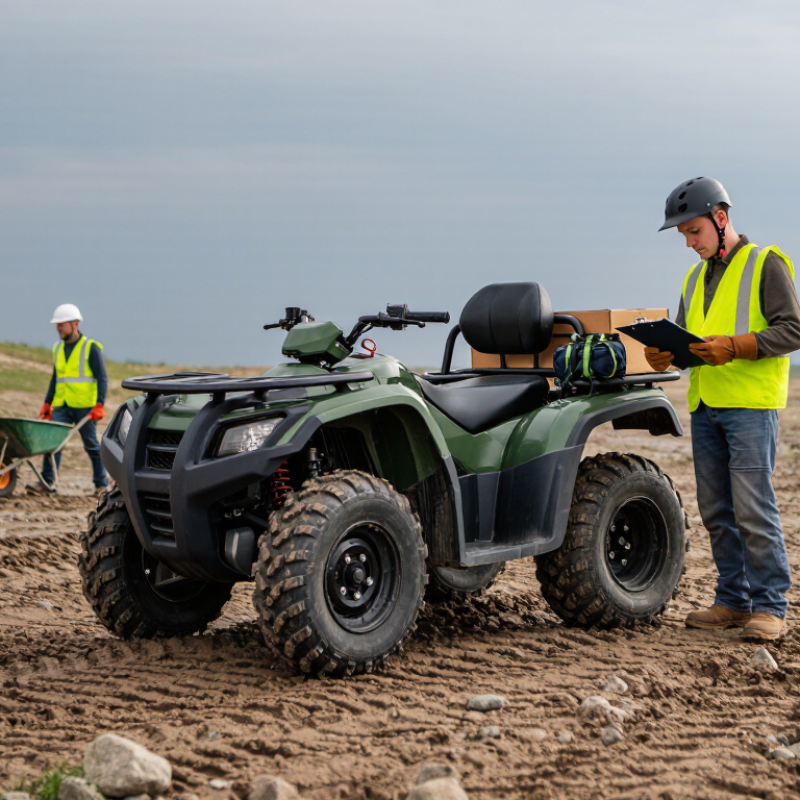
Choosing an Automatic Atv can help a business move people, tools, and supplies across rough ground with fewer manual gear changes. That can matter on a farm, a large worksite, or a trail-maintenance route where stops and starts are frequent. It is not a productivity guarantee. The right choice depends on terrain, load, operating hours, and rider experience.
The U.S. Bureau of Economic Analysis reported that outdoor recreation contributed about $1.2 trillion in value added to the U.S. economy in 2023, representing 2.3% of GDP. This broad figure includes many activities, not ATV businesses alone, but it shows the scale of the outdoor recreation economy. For operators, equipment decisions can affect daily workflow and operating costs. An automatic transmission may simplify vehicle operation for some tasks, while cargo capacity, fuel use, service access, and purchase price still need careful comparison.
Safety belongs in the business case. The U.S. Consumer Product Safety Commission tracks ATV-related injuries and fatalities in its annual reports, underscoring the need for training and suitable protective equipment. A machine that feels easy to operate is not risk-free. That distinction is easy to overlook. Before buying, compare models under realistic conditions: a loaded trailer, a muddy incline, or repeated short trips. Automatic models may fit some fleets well, but not every route or budget. That is worth questioning. A measured trial can reveal more than a brochure.
An automatic ATV typically uses a continuously variable transmission (CVT). Two variable-width pulleys and a reinforced belt adjust the drive ratio as engine speed and load change. Instead of shifting through fixed gears, the system can keep the engine within a useful power range. On a worksite, that means smoother starts when towing a small trailer or climbing a muddy incline. Less gear juggling.
The U.S. Department of Energy’s fuel-economy guidance reports potential gains of about 4–8% for CVTs compared with conventional automatic transmissions in passenger vehicles. That is a useful reference, not an ATV performance guarantee. Vehicle weight, payload, terrain, tire pressure, and maintenance all affect results. SAE technical literature also explains how CVT ratio control can match engine speed to changing load, but calibration differs across machines and applications.
For commercial work, the practical benefit is controlled power delivery at low speeds. An operator can ease forward while positioning a sprayer or hauling tools across uneven ground. The belt and pulleys still need care. Dust, heat, heavy loads, and abrupt throttle inputs can accelerate wear. Not every task fits. A CVT may feel less direct than a manual transmission, and operators should check the machine’s load limits before towing.
How CVTs deliver power for commercial work
A CVT changes its ratio continuously rather than shifting through fixed gears. A lower ratio can multiply torque at the wheels for slow, demanding work; a higher ratio favors travel speed. The chart uses example ratios and ideal calculations: actual torque depends on engine output, gearing, and transmission losses.
Business fit comes down to the numbers on each OEM specification sheet: rated payload, towing capacity, and fuel use. Match payload to the real load, including tools, racks, and the rider. A 250-pound cargo rating can disappear quickly when wet soil or a full sprayer is added. Check whether towing capacity assumes a braked trailer, and confirm any tongue-weight limit. Small print matters.
Fuel figures need careful comparison. The U.S. EPA’s NONROAD model estimates off-road equipment fuel use by equipment class and operating conditions; it does not provide one universal ATV miles-per-gallon rating. Compare OEM figures only when test conditions match, then track actual gallons per operating hour on your routes. A simple log helps: start with a full tank, record hours, terrain, load, and refills. Muddy slopes and frequent stops can change consumption. The estimate may still be rough.
Automatic transmission can reduce shifting work on stop-start routes, but it does not increase a machine’s rated capacity. For a fleet, compare two or three candidate models using the same payload and towing tasks. Record fuel used across a full workweek, not just one easy day. The U.S. CPSC’s ATV injury reports also reinforce the value of respecting operating limits; heavier loads can affect handling. Recheck the manual before hauling. A little inconvenient, but worthwhile.
An automatic ATV can reduce repeated gear changes during hauling, inspection, or property maintenance. But convenience alone does not prove a business is more productive. Measure cycle time on a consistent task, such as carrying tools between a storage shed and a work site. Record the load, route, surface, and operator. A phone timer and a simple daily log can reveal whether each trip takes four minutes or ten.
Track downtime as carefully as moving time. Note delays for refueling, routine checks, repairs, and waiting for another task. Small gaps add up. Our first spreadsheet was too tidy; it missed short stops that operators considered “nothing.” Those minutes still affect schedules. Compare similar shifts and note rain, mud, steep ground, or unusually heavy loads, since these can distort the results.
Cost per operating hour offers another useful view. Divide fuel, scheduled service, repairs, tires, and other operating expenses by recorded engine hours. Keep labor costs separate or include them consistently, and state which method you use. An ATV with a shorter cycle time may still cost more if it needs frequent service. Review the figures monthly, then adjust routes, maintenance timing, or task assignments based on what the records actually show. One month is not a trend.
An automatic ATV can simplify fleet training: operators focus on throttle, braking, and terrain instead of manual gear changes. That helps, but it is not a safety system. The U.S. Consumer Product Safety Commission’s 2021 Annual Report on ATV-Related Deaths and Injuries estimated 104,000 ATV-related injuries treated in U.S. emergency departments that year. Each injury points to real exposure, often involving a rollover, collision, or loss of control.
Build safety planning around the route. Mark slopes, loose gravel, blind corners, water crossings, and pedestrian areas before dispatch. Set low-speed zones near loading bays, require properly fitted helmets, and match vehicle size to operator experience. Automatic transmission may reduce gear-selection distraction, but it cannot prevent a rollover on a side slope. CPSC safety guidance also stresses training and avoiding paved roads. Put these controls in written checklists and operator briefings.
Keep records of near misses, not just injuries. A rider who brakes hard at a blind corner may reveal a problem before anyone gets hurt. Review incidents with operators and update route markings or speed limits. Even a careful map misses something. That is worth admitting.
| Safety indicator | CPSC data or guidance | Business safety-planning application | What an automatic ATV changes—and does not change |
|---|---|---|---|
| Emergency-department-treated injuries | CPSC estimated approximately 96,700 ATV-related injuries in 2021 treated in U.S. hospital emergency departments. | Include a documented pre-ride briefing, supervised practice, route hazard checks, and a process for reporting near misses and injuries. | Automatic transmission may reduce the need to shift gears, but it does not eliminate collision, loss-of-control, or rollover hazards. |
| Reported fatalities | CPSC’s ATV fatality reporting recorded 525 deaths for 2019. Fatality totals are reported counts and may be revised as additional information becomes available. | Treat fatality data as a reason to plan for prevention and emergency response, not as a prediction of risk for a particular vehicle, route, or worksite. | Transmission type alone is not evidence that an ATV is safer. Select and operate a vehicle appropriate to the task, rider, and terrain. |
| Helmet use | CPSC safety guidance advises ATV riders to wear a helmet designed for motor-vehicle use, along with eye protection and other appropriate protective gear. | Provide correctly fitting helmets and required protective equipment; check condition and use before every ride. | An automatic transmission does not replace protective equipment or safe riding practices. |
| Passengers and vehicle design | CPSC advises riders not to carry a passenger on a single-rider ATV. Passengers should ride only on an ATV designed by its manufacturer to carry a passenger. | Match the vehicle’s seating design to the job and prohibit unauthorized passengers through written operating rules. | Automatic operation does not increase the vehicle’s passenger capacity or make an unsuitable vehicle appropriate for two riders. |
| Young riders and vehicle size | CPSC guidance says children under 16 should not ride adult-sized ATVs and should use age-appropriate vehicles with adult supervision. | Set minimum rider-age and training requirements, verify that the rider can control the vehicle, and follow the manufacturer’s age recommendation. | Ease of shifting is not a substitute for an appropriately sized ATV, adequate supervision, or demonstrated riding competence. |
| Training and operating conditions | CPSC recommends completing hands-on ATV safety training and following the vehicle’s operating instructions. Risk can be affected by rider behavior, terrain, speed, and conditions. | Use trained, authorized operators; inspect vehicles; set speed and route limits; and stop work when visibility, weather, or terrain makes riding unsafe. | An automatic ATV may simplify one aspect of operation, but training, supervision, maintenance, and hazard controls remain essential. |
Sources: U.S. Consumer Product Safety Commission (CPSC), 2021 Annual Report of ATV-Related Deaths and Injuries and CPSC ATV safety guidance. Injury figures are estimates of emergency-department-treated cases; fatality figures are reported counts. These measures are compiled differently and should not be directly compared. An automatic transmission is an operational feature, not a guarantee of increased safety.
An automatic ATV can simplify training and reduce shifting errors when crews move between muddy trails, gravel yards, and work sites. For fleet selection, compare scheduled service intervals, warranty coverage, and total lifetime cost—not just purchase price. Ask dealers for written maintenance schedules, including oil, belt, air-filter, and valve checks. Intervals vary by operating conditions, and dusty work can shorten them. The U.S. Bureau of Labor Statistics’ Consumer Price Index tracks motor-vehicle maintenance and repair costs; its data showed continued price increases in recent years. It is not an ATV cost forecast, but it is a useful reminder to budget for rising labor and parts. One awkward truth: a cheap unit can become expensive if downtime interrupts paid work.
Compare warranty length, covered components, exclusions, and required service records side by side. Then estimate five-year costs: purchase, fuel, scheduled service, tires, repairs, and resale value. Use your own work logs where possible. A 20-minute daily inspection may reveal a cracked boot or loose fastener before a field failure. Still, spreadsheets can overstate certainty; terrain and operator habits are hard to predict.
Tips: Request service intervals in hours, not just months. Record engine hours, repair dates, and parts costs for every unit. Price a common wear item before buying, and check whether warranty work requires an authorized service location.
Two adjustable pulleys and a reinforced belt change the drive ratio as speed and load shift. No fixed-gear shifting. The system helps keep engine power useful.
It can make low-speed work easier, such as positioning a sprayer or towing a small trailer. Muddy slopes still demand care.
No. Passenger-vehicle estimates suggest possible gains, but they do not guarantee ATV results. Load, terrain, tire pressure, and maintenance all matter.
Check the rated payload, towing limit, and tongue-weight limit in each machine’s specifications. Include the rider, racks, tools, and wet soil. Small print matters.
Start with a full tank. Record operating hours, terrain, loads, and refills, then calculate gallons per hour. One easy day is not enough.
Time a repeated task, such as carrying tools from a shed to a worksite. Record the route, surface, load, and operator. Short stops count too.
Include fuel, scheduled service, repairs, tires, and other operating costs. Divide by recorded engine hours. Keep labor separate, or include it consistently.
Dust, heat, heavy loads, and abrupt throttle inputs can increase belt wear. Check the manual and respect load limits. We may miss small warning signs.
An Automatic Atv can simplify commercial work by using a continuously variable transmission (CVT) to adjust power delivery without manual gear changes. This can help operators manage changing terrain and workloads, but the right vehicle depends on the job. Compare manufacturer-rated payload and towing capacity with the loads you expect to carry or pull, and consider fuel use under realistic operating conditions rather than relying on a single headline figure.
To assess productivity, track task cycle times, maintenance-related downtime, and cost per operating hour across the fleet. Build safety planning around suitable training, protective equipment, operating procedures, and current CPSC data on ATV-related deaths and injuries. Before choosing a model, compare service intervals, warranty terms, parts availability, and projected lifetime costs. Looking at these factors together can help a business select an ATV that supports dependable work while fitting its budget and safety needs.

VETOR GROUP