Choosing reliable Car Brake Pads is a safety decision, not merely a purchasing exercise. Global buyers must compare friction consistency, heat resistance, wear life, noise control, and vehicle compatibility. A pad that performs well on a quiet city hatchback may struggle on a loaded commercial van. Conditions matter.
Richard Reina, an automotive expert and former automotive instructor, has often stressed, “Brakes are not the place to cut corners.” This principle fits international sourcing. Serious manufacturers should provide traceable materials, controlled production, documented testing, and consistent batch performance. Look for evidence such as ISO 9001 systems, laboratory friction testing, dynamometer results, and compliance with applicable regional standards. Certificates alone are not enough.
Details reveal production discipline. Check chamfer accuracy, backing-plate coating, shim attachment, edge finishing, and packaging protection. Ask whether the supplier tests cold braking, repeated high-temperature stops, dust levels, and noise under realistic conditions. A dependable factory should explain its formula without hiding behind vague marketing language.
Not every “top” manufacturer fits every buyer.
Some suppliers excel in passenger-car coverage. Others focus on trucks, buses, electric vehicles, or private-label programs. Product data, warranty terms, minimum order quantities, and technical support deserve equal attention. Even experienced purchasing teams can miss small fitment differences. That mistake becomes expensive after shipment.
This guide examines ten leading Car Brake Pads manufacturers for global buyers. It considers manufacturing capability, quality controls, market experience, product range, and export reliability. The ranking is not absolute. Regional requirements and actual driving conditions can change the best choice. Careful verification remains essential.
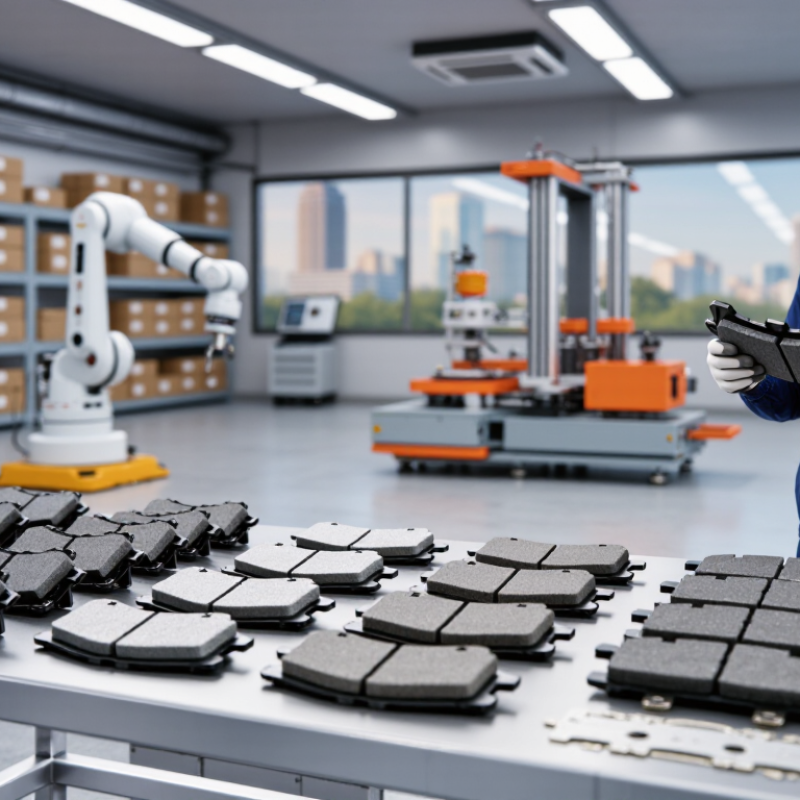
China’s car brake pad manufacturing industry has grown from basic replacement production into a technically diverse supply network. Manufacturers now produce ceramic, semi-metallic, and low-metallic formulations for passenger cars, commercial vehicles, and export markets. Experienced buyers examine more than price. They review raw material control, mixing records, pressing temperatures, curing cycles, and final inspection data.
A reliable factory should provide dimensional reports, friction test results, wear measurements, and batch traceability. Testing may include dynamometer performance, compressibility, shear strength, noise evaluation, and corrosion checks. Quality systems such as IATF 16949 can indicate process discipline, but certification alone proves little. Regional approval requirements also matter. Packaging, labeling, and documentation must match the destination market. A clean sample can still hide unstable production. This is where many purchasing decisions become too optimistic.
Tips: Request samples from several production batches, not one carton. Compare pad thickness, chamfer quality, coating coverage, and backing plate finish. Ask for test conditions, not only attractive numbers. Confirm whether the factory controls friction material internally or relies heavily on outside suppliers. Inspect how workers store materials, because humidity and contamination can affect consistency. Video calls help, but an independent audit gives stronger evidence. Keep communication precise. Small misunderstandings about vehicle applications can create expensive returns. Even experienced buyers sometimes overlook noise behavior after installation, especially when testing only on a short route.
Ranking China’s top brake pad manufacturers requires more than checking factory size or export volume. A serious evaluation begins with braking performance. Buyers should review friction stability, wear rate, fade resistance, recovery after overheating, and stopping distance. Tests should cover cold starts, heavy traffic, mountain descents, and wet conditions. Laboratory figures matter, but they do not tell the entire story.
Material control is equally important. Reliable manufacturers document fiber content, resin selection, steel backing quality, and batch traceability. Production lines should include pressing pressure checks, curing records, grinding measurements, and final inspection. Certifications can support credibility, but independent test reports are stronger evidence. Ask whether samples match mass-production batches. They sometimes do not.
Experience also appears in practical details. A capable supplier understands different vehicle platforms, rotor conditions, climate zones, and packaging requirements. Clear technical drawings, stable lead times, responsive engineers, and realistic warranty terms deserve careful weighting. An on-site audit can reveal housekeeping, calibration habits, and operator training within hours. Small warning signs matter.
No ranking stays perfect. Road conditions differ, and one compound may perform well in Europe but feel noisy in tropical traffic. Some evaluations also overvalue price. That is a mistake. A lower purchase cost can become expensive through dust complaints, uneven wear, or repeated returns. Buyers should compare verified data, field feedback, and after-sales records before assigning a final position.
China’s Top 10 Car Brake Pad Manufacturers for Global Buyers should be assessed beyond catalog size. OICA reported 93.5 million motor vehicles produced worldwide in 2023. China contributed about 30.2 million units, creating strong demand for reliable friction components. CAAM also reported China’s new-energy vehicle sales exceeded nine million units in 2023. This shift increases the need for pads tested under regenerative braking and repeated urban stops.
A practical supplier review should examine IATF 16949 certification, batch traceability, dynamometer testing, and stable friction performance. Ask for test results covering noise, wear, temperature, and compressibility. ECE R90 approval may matter in European markets, while FMVSS requirements apply in the United States. The top ten candidates should also provide production photographs, sample reports, and clear material declarations. Be careful with impressive claims. A certificate alone does not prove consistent factory control.
Tips: Request three sample batches, not one. Measure thickness, hardness, and weight independently. Compare cold and hot braking data. Check packaging before shipment; damaged labels create costly confusion. Buyers should clarify vehicle applications and climate conditions early. Some suppliers communicate quickly but document poorly. That weakness deserves attention. A small pilot order may reveal more than a polished presentation. Industry reports offer useful market direction, but direct audits and repeat testing remain essential for dependable purchasing decisions.
China Top 10 Car Brake Pads Manufacturers for Global Buyers
When evaluating China’s top ten brake pad manufacturers, product quality should come before price. Experienced buyers inspect friction consistency, backing plate strength, chamfer accuracy, and wear patterns. A reliable factory should provide batch records, laboratory results, and samples from current production. Small details matter. Uneven chamfers can create noise or poor pedal feel.
Certifications help verify manufacturing discipline, but they do not replace independent testing. Look for ISO 9001 or IATF 16949 quality systems, where applicable, and check compliance with regional requirements such as ECE R90. Test reports should identify the formula, vehicle application, test method, and production batch. During supplier audits, confirm that raw materials are traceable from incoming inspection to final packaging. Certificates alone can mislead. Their validity and scope need careful review.
Export capability also separates dependable suppliers from occasional sellers. Strong manufacturers can prepare multilingual labels, fitment charts, palletized cartons, customs documents, and consistent lead-time updates. Ask whether they support mixed stock-keeping units and replacement orders. Inspect packaging for moisture protection, barcode accuracy, and clear installation instructions. Some factories communicate well before payment but respond slowly after shipment. That weakness deserves attention. Global buyers should compare factory visits, third-party inspections, warranty procedures, and response records. The best choice is not always the largest supplier, but the one that repeatedly delivers verified quality with transparent evidence.
Choosing among China’s top ten car brake pad manufacturers requires more than comparing prices. OICA reported 93.5 million motor vehicles produced worldwide in 2023. That scale increases demand, but it also rewards careful supplier screening.
Ask each supplier for recent dynamometer results, friction-coefficient data, wear measurements, and batch traceability records. Check whether testing follows relevant UNECE Regulation No. 90 requirements or equivalent national standards. A valid IATF 16949 certificate can support process confidence, but it does not replace product-level verification. Review the certificate scope, issuing body, expiry date, and factory address. Request samples from normal production, not specially prepared units.
Look closely at the physical details. Measure backing-plate thickness, chamfer accuracy, surface finish, and fitting tolerance. Inspect packaging for part numbers and moisture protection. Independent laboratory testing should cover braking performance, noise, shear strength, and high-temperature behavior. UNECE’s regulatory framework highlights consistent replacement-part performance, while OICA’s production data shows why supply continuity matters. Ask about mold ownership, raw-material controls, annual capacity, and corrective-action records. A polished factory tour proves little. Low quotations can hide unstable materials or weak inspection. I have learned that even experienced buyers overlook small labeling errors. Build a trial order, inspect several batches, and keep written acceptance criteria before signing a long-term agreement.
| Supplier Profile | Primary Manufacturing Region | Product Coverage | Friction Material Options | Manufacturing & Tooling Capability | Quality and Testing Evidence to Request | Export Readiness Indicators | Typical MOQ | Typical Production Lead Time | Best Fit for Global Buyers |
|---|---|---|---|---|---|---|---|---|---|
| 01 ★★★★☆ |
Shandong | Passenger cars Light commercial vehicles | Low-metallic, ceramic, and semi-metallic formulations | Hot pressing, grinding, chamfering, slotting, powder coating, and automated thickness control | IATF 16949 or ISO 9001 certificate; dynamometer test reports; batch traceability; shear-strength records | OEM drawings, barcode labels, export cartons, and multilingual packaging support | 500–1,000 sets per part number | 35–50 days after approval | Importers seeking broad passenger-car coverage and private-label packaging |
| 02 ★★★★☆ |
Zhejiang | Passenger cars SUVs EV applications | Low-dust ceramic and copper-free formulations | Precision backing-plate stamping, adhesive bonding, CNC profiling, and electronic wear-sensor assembly | ECE R90 approval where applicable; material inspection; compressibility testing; noise and vibration evaluation | Experience with European catalogues, product photographs, and digital SKU management | 300–800 sets per part number | 30–45 days after sample sign-off | European distributors prioritizing low dust, low noise, and modern vehicle coverage |
| 03 ★★★★☆ |
Jiangsu | Passenger cars Commercial vehicles Fleet applications | Semi-metallic, low-metallic, and heavy-duty non-asbestos materials | High-volume molding, automatic riveting, plate painting, grinding, and in-line visual inspection | Lot-based friction testing; hardness and density reports; coating adhesion checks; corrective-action records | Stable container planning, palletized loading, and regular export documentation | 800–1,500 sets per part number | 40–60 days for repeat orders | Large wholesalers and fleet-parts suppliers requiring repeatable volume production |
| 04 ★★★★☆ |
Hebei | Passenger cars Light trucks Agricultural vehicles | Semi-metallic and economical low-metallic formulations | Mechanical stamping, hot molding, drilling, painting, and manual final inspection | Incoming-material inspection; friction coefficient records; dimensional inspection; packaging drop testing | Competitive mixed-SKU loading and flexible carton quantities | 500–1,000 sets per part number | 35–55 days | Price-sensitive buyers serving developing markets and independent repair networks |
| 05 ★★★★★ |
Hubei | Commercial vehicles Buses Trucks | Heavy-duty semi-metallic and non-asbestos formulations | Large-format presses, reinforced backing plates, riveting, grinding, and high-load friction testing | High-temperature friction testing; shear testing; compressibility testing; batch and raw-material traceability | Heavy-duty packaging, pallet standards, and documentation for fleet maintenance programs | 300–800 sets per part number | 45–65 days | Commercial-vehicle distributors requiring thermal stability and wear resistance |
| 06 ★★★★☆ |
Guangdong | Passenger cars Export replacement market | Ceramic, low-metallic, and copper-free formulations | Automated profiling, surface treatment, laser marking, electronic wear-sensor installation, and custom tooling | Material safety data; vehicle-application validation; noise testing; dimensional capability studies | Fast sample development, English communication, and barcode or QR-code labelling | 200–600 sets per part number | 25–45 days after tooling approval | Online aftermarket sellers and distributors needing packaging customization and quick development |
| 07 ★★★★☆ |
Fujian | Passenger cars SUVs Light commercial vehicles | Low-metallic, ceramic, and hybrid formulations | Hot pressing, CNC grinding, chamfering, slotting, and automated packaging inspection | Friction-material batch records; surface-finish checks; plate-thickness reports; process-control plans | Mixed-model consolidation and support for regional aftermarket catalogues | 400–900 sets per part number | 35–50 days | Regional importers balancing product variety, moderate MOQs, and stable quality |
| 08 ★★★☆☆ |
Anhui | Passenger cars Light trucks | Economical semi-metallic and low-metallic formulations | Conventional molding, mechanical grinding, riveting, powder coating, and sampling inspection | ISO 9001 evidence; incoming inspection; hardness testing; basic friction and dimensional reports | Flexible carton artwork and mixed-container loading, subject to order planning | 600–1,200 sets per part number | 40–60 days | Buyers prioritizing competitive landed cost for standard, high-volume applications |
| 09 ★★★★☆ |
Chongqing | SUVs Pickup trucks Commercial vehicles | Semi-metallic, low-metallic, and high-temperature formulations | Reinforced plate stamping, hot pressing, CNC finishing, wear-sensor assembly, and durability testing | Heat-cycle reports; shear-strength records; plate-flatness inspection; application-based validation samples | Experience with left-hand-drive and right-hand-drive catalogue requirements | 300–700 sets per part number | 40–55 days | Exporters serving pickup, SUV, and mixed-road-use vehicle markets |
| 10 ★★★★☆ |
Liaoning | Passenger cars Heavy-duty vehicles Cold-climate markets | Low-metallic, semi-metallic, and cold-temperature optimized formulations | Hot molding, backing-plate coating, precision grinding, anti-corrosion treatment, and batch inspection | Corrosion-resistance testing; low-temperature evaluation; friction coefficient reports; traceable inspection records | Export packaging, moisture protection, palletization, and documentation for long-distance shipping | 500–1,000 sets per part number | 45–65 days | Buyers supplying northern climates, long-distance transport, and corrosion-sensitive markets |
Quality affects braking consistency, noise, wear, and pedal feel. Check friction stability, backing-plate strength, chamfer accuracy, and surface finish. Low prices can hide unstable materials.
Request batch records, material declarations, laboratory reports, and current production samples. Check certification scope, factory address, expiry date, and issuing body. A certificate alone proves little.
Ask for dynamometer results covering cold and hot braking conditions. Review friction coefficient, wear, noise, temperature, and compressibility data. Independent testing adds useful evidence.
Request at least three normal production batches. Measure thickness, hardness, weight, and fitting tolerance independently. One perfect sample can mislead.
Check uneven chamfers, backing-plate thickness, surface finish, and edge damage. Inspect each pad under clear light. Small defects can create noise or poor pedal feel.
The supplier should prepare accurate part numbers, multilingual labels, customs documents, and palletized cartons. Confirm moisture protection and barcode accuracy. Packaging problems become expensive later.
Ask for testing under regenerative braking and repeated urban stops. Review heat behavior and friction consistency during frequent braking. Experience claims need supporting records.
A factory visit can reveal equipment, storage, and inspection practices. It cannot confirm long-term consistency by itself. I may still overlook a small labeling error.
Use a small order with several applications or batches. Define acceptance limits for thickness, weight, noise, and documentation. Keep written records before signing a long-term agreement.
Track response times before and after shipment. Ask for corrective-action records and replacement procedures. Fast replies are helpful, but complete documents matter more.
China has become a major source of Car Brake Pads for global buyers, supported by large-scale production, improving engineering capabilities, and well-developed export networks. This article explains the structure of China’s brake pad manufacturing industry and presents a practical framework for evaluating leading suppliers. Key ranking criteria include product consistency, raw material control, research and development capacity, manufacturing technology, quality management, production scale, delivery reliability, and customer service.
It also examines how buyers can assess product quality, internationally recognized certifications, testing procedures, and export capabilities before placing an order. The featured selection is intended to help importers, distributors, wholesalers, and automotive businesses compare potential suppliers more efficiently. By reviewing technical specifications, market experience, customization options, minimum order requirements, communication standards, and after-sales support, global buyers can identify a dependable Chinese manufacturer that matches their vehicle applications, budget, compliance needs, and long-term purchasing plans.

VETOR GROUP