Top Brake Pad Set Manufacturers for Global Buyers?

Time:2026-10-20 Author:Madeline
0%

Choosing among the top Brake Pad Set manufacturers requires more than comparing catalog prices. Global buyers must examine friction consistency, backing-plate quality, noise control, thermal performance, and vehicle fitment. A reliable manufacturer should provide batch traceability, laboratory test data, clear packaging, and stable production capacity. These details matter when a shipment contains thousands of sets for different climates and driving conditions.

Automotive educator James D. Halderman has emphasized, “The brake system is the most important safety system on a vehicle.” That principle should guide every purchasing decision. A strong Brake Pad Set supplier should explain its material formulation, quality-control process, testing methods, and applicable regional requirements. Buyers should also inspect edge finishing, shim installation, wear indicators, and corrosion protection. Small defects can create large warranty problems.

Price still matters. It should not lead the decision.

Experienced buyers often request samples before signing long-term contracts. They compare stopping feel, dust levels, rotor wear, and performance after repeated heat cycles. They also review supplier communication, because delayed technical answers can signal weak support. However, no manufacturer is perfect for every market. Some suppliers excel in passenger cars, while others specialize in commercial fleets or premium applications.

This guide evaluates leading Brake Pad Set manufacturers through practical and measurable criteria. It also recognizes an uncomfortable reality: published specifications may not fully reflect road performance. Independent testing, customer feedback, and careful trial orders remain necessary. A dependable choice is not always the cheapest one, but it should be transparent, consistent, and willing to prove its claims.
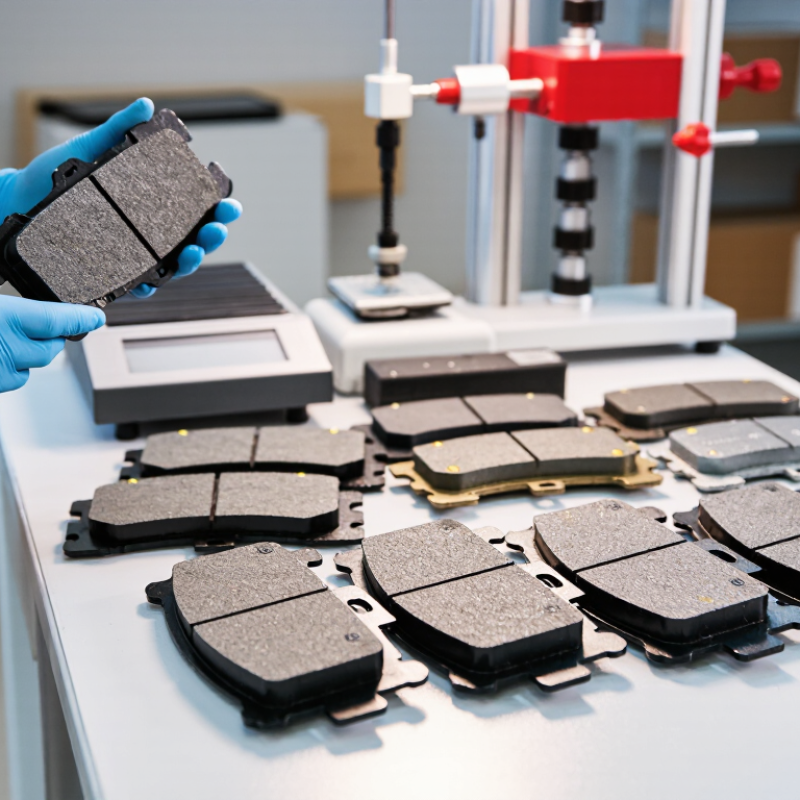
Top Brake Pad Set Manufacturers for Global Buyers?

Brake Pad Set Manufacturing: Materials, Design, and Production Standards

Top Brake Pad Set Manufacturers for Global Buyers

Brake pad manufacturing starts with friction material selection. A typical compound may combine resin, fibers, abrasives, lubricants, and fillers. Each ingredient changes stopping power, noise, wear, and heat response. Ceramic blends often run quietly, while semi-metallic formulas handle severe heat effectively.

Heat changes everything. The choice depends on vehicle mass, rotor type, climate, and driving cycles. Experienced plants test incoming materials before pressing begins.

Design work translates these materials into a controlled pad set. Engineers check backing-plate thickness, chamfer angles, slots, and wear-sensor placement. A precise fit prevents movement inside the caliper bracket.

Fit matters. Coating coverage also matters in wet regions. Poor preparation can cause corrosion beneath the friction layer. Production trials may reveal uneven contact marks after small dimensional errors. Not every noise issue comes from the pad. Rotor condition and bedding procedures also influence results.

Reliable manufacturers control mixing, molding pressure, curing temperature, grinding, and final inspection. They use traceable batches and sample pads for friction, shear, compressibility, and high-temperature testing.

Quality systems such as ISO 9001 and IATF 16949 can support repeatable processes. However, certification alone proves little without current test records and corrective-action evidence.

Global buyers should request drawings, material declarations, and inspection results for each application. Results can vary. Laboratory performance may not mirror every road condition, so field feedback remains important.

How to Evaluate Brake Pad Set Manufacturers for Global Purchasing

Choosing brake pad set manufacturers for global purchasing requires more than comparing unit prices. A reliable supplier should provide clear fitment data, friction material specifications, and consistent batch records. Ask for samples before placing a large order. Inspect pad thickness, chamfer quality, backing plate alignment, and packaging strength.

Request independent test reports covering braking performance, wear, noise, temperature resistance, and corrosion protection. Check whether the manufacturer follows a documented quality system, such as ISO 9001, and whether production records are traceable. Factory experience matters too. A supplier serving different climates should understand humidity, mountain driving, heavy traffic, and long-distance transport. Video inspections help, but an on-site audit reveals more. Sometimes, the cleanest factory photos are not enough.

Tips: Compare samples from two or three production batches. Ask how rejected parts are separated and recorded. Confirm labeling, carton dimensions, pallet details, and replacement procedures before shipment. Measure delivery reliability over several orders, not one successful transaction.

Communication is another practical test. Technical staff should answer questions with measurements, not vague promises. They should explain material changes and approve them before production. I have seen buyers focus heavily on price and overlook inconsistent stopping feel. That mistake becomes expensive after installation. Even experienced purchasing teams can miss small details, especially when specifications are translated poorly. Use signed drawings, inspection checklists, and retained samples. Leave room for review. Specification sheets can be wrong.

Leading Manufacturer Categories Across the Global Brake Pad Market

Global brake pad manufacturers typically fall into several market categories: original equipment suppliers, replacement aftermarket producers, performance specialists, and heavy-duty manufacturers. Each category serves different driving conditions and purchasing priorities. Original equipment suppliers focus on consistent fit, validated friction behavior, and production traceability. Aftermarket producers usually offer broader vehicle coverage and more competitive pricing. Performance manufacturers develop pads for heat resistance, repeated braking, or demanding road use.

Heavy-duty manufacturers design pads for trucks, buses, trailers, and industrial fleets. Their products must handle higher loads, longer duty cycles, and frequent inspections. Material choices may include ceramic, semi-metallic, low-metallic, or application-specific friction compounds. However, material names alone do not prove quality. Buyers should review test data, temperature ranges, noise performance, wear rates, and compatibility with the target rotor. No category is automatically best. In practice, a cheaper pad can become expensive when dust, noise, or uneven wear creates service problems.

Tips: Request batch records, technical data sheets, and independent test evidence before placing large orders. Check packaging, edge finishing, shim installation, and slot design on physical samples. Ask how the manufacturer controls friction consistency between production lots. A minor weakness may appear only after several weeks of delivery use, so sample testing should include cold starts, stop-and-go traffic, and repeated downhill braking. One overlooked detail can affect customer trust.

Quality Certifications, Testing Methods, and Compliance Requirements

Global buyers should evaluate brake pad manufacturers through verified quality systems, not attractive product claims. ISO 9001 shows controlled procedures, while IATF 16949 indicates stronger automotive quality management. These certifications support consistency, but they do not automatically prove braking performance. Check certificate scope, issuing body, expiration date, and production site.

Reliable suppliers use several testing methods before shipment. Dynamometer tests measure friction stability, fade, recovery, wear, and noise under changing temperatures. Shear strength and compressibility tests examine structural safety. Corrosion testing can reveal problems after salt exposure. Some laboratories also inspect material composition and backing plate bonding. Results should identify test conditions, sample numbers, equipment, and acceptance limits. Without those details, a report is difficult to trust.

Compliance depends on the destination market and vehicle application. Buyers may need evidence related to UNECE R90, FMVSS 135, or applicable national standards. Request batch traceability, declarations of conformity, laboratory accreditation, and production inspection records. Independent testing is valuable when orders are large or specifications differ. A certificate alone proves little. Even experienced purchasing teams can miss changes in regional requirements. That weakness deserves regular review. Suppliers should also explain deviations instead of hiding them, because real production is not perfectly uniform.

Top Brake Pad Set Manufacturers for Global Buyers? - Quality Certifications, Testing Methods, and Compliance Requirements

Evaluation Dimension Relevant Standard or Requirement What Global Buyers Should Verify Typical Evidence or Test Record Main Market Relevance
Quality management system ISO 9001:2015 Confirm that the certificate covers the manufacturing site and relevant activities, including design, production, inspection, and corrective action. Valid certificate, accreditation details, scope statement, audit status, and certificate expiry date. Global supply chains; certification is for the management system, not automatic proof of product approval.
Automotive production controls IATF 16949:2016 Check site-specific certification, customer-specific requirements, control plans, process capability, traceability, and change-management procedures. IATF certificate, process audit results, PFMEA, control plan, measurement-system analysis, and production-part approval records. Automotive OEM and Tier 1 purchasing; often requested for production programs.
Replacement-part type approval UNECE Regulation No. 90 Verify approval for the exact pad set, vehicle application, axle position, friction material, backing plate, and packaging configuration. Type-approval certificate, approval number, conformity-of-production records, required marking, and application list. Replacement brake linings and pads sold in markets applying UNECE requirements.
Vehicle braking performance FMVSS No. 135 for light vehicles; FMVSS No. 105 for hydraulic and electric brake systems Determine whether the product is supplied as part of a vehicle compliance program or as an aftermarket component; verify vehicle-level responsibility and fitment limits. Vehicle or axle dynamometer reports, burnish procedure, cold and hot effectiveness results, recovery data, and wear measurements. United States; requirements depend on vehicle category and compliance pathway.
Friction performance classification SAE J661 friction identification and applicable local marking rules Request the tested friction range and temperature conditions; do not treat a friction code alone as a complete safety certification. Friction test data, coefficient-of-friction values, temperature points, sample identification, and laboratory calibration records. Commonly referenced in North American aftermarket product documentation.
Dynamometer validation SAE J2522, commonly known as the AK Master dynamometer procedure Review inertia, speed, pressure, temperature, burnish cycles, stop schedule, and acceptance criteria used for the specific application. Full dynamometer cycle report, friction-versus-temperature graphs, wear rate, fade, recovery, and post-test inspection. International product development and comparative validation; the procedure itself is not a universal legal approval.
Shear strength and attachment integrity Applicable regulatory, customer, and internal engineering specifications Confirm bond or mechanical attachment design, minimum shear values, test direction, conditioning, and failure-mode criteria. Shear-test results, sample conditioning records, fracture-location analysis, backing-plate inspection, and batch traceability. All markets; particularly important for bonded, riveted, or mechanically retained pad constructions.
Compressibility and dimensional stability Customer engineering specifications and applicable aftermarket approval requirements Check compressibility under defined load and temperature, thickness tolerance, parallelism, chamfer, slot, and backing-plate dimensions. Compression curves, hot and cold measurements, dimensional inspection reports, and gauge calibration records. Global fitment control; dimensional variation can cause noise, drag, uneven wear, or installation problems.
Noise, vibration, and harshness Application-specific NVH test procedures; SAE and customer laboratory methods where specified Ask whether testing used the target caliper, rotor, shims, hardware, temperature range, humidity, and vehicle configuration. Noise-event frequency and amplitude data, test matrix, environmental conditions, hardware configuration, and corrective-action records. Passenger-car aftermarket and original-equipment applications; results are highly system-dependent.
Chemical and environmental compliance EU REACH, EU End-of-Life Vehicles Directive, and destination-market substance restrictions Obtain material declarations for friction material, coatings, adhesives, shims, packaging, and any intentionally added substances. Supplier declarations, restricted-substance test reports, safety data where applicable, and material composition records. European Union and other jurisdictions adopting chemical or heavy-metal restrictions.
Production consistency Conformity-of-production controls, statistical process control, and customer-specific quality requirements Review lot definition, incoming-material controls, mixing records, curing parameters, final inspection, and retained samples. Batch records, SPC charts, capability indices, final inspection results, retained-sample policy, and nonconformance reports. Essential for repeat orders, private-label programs, and regulated replacement-part supply.
Traceability and packaging Applicable approval-marking, labeling, packaging, and product-liability requirements Verify part number, vehicle application, axle position, batch code, approval marking where required, installation instructions, and warning information. Packaging artwork approval, barcode records, label inspection, batch-to-raw-material linkage, and shipping-condition checks. All export markets; labeling details vary by jurisdiction and approval status.

Export Capability, Pricing Factors, and Long-Term Supplier Support

Top Brake Pad Set Manufacturers for Global Buyers?

For global buyers, export capability should be judged beyond a polished catalog. Reliable manufacturers provide consistent technical documents, accurate packing lists, traceable batch numbers, and clear shipment schedules. Ask for friction-test records, material specifications, packaging photos, and sample labels before placing a large order. A factory that answers slowly may create bigger problems during customs clearance or warranty reviews. Small details matter.

Pricing reflects more than the brake pad itself. Raw material formulation, backing plate quality, tooling, laboratory testing, packaging, order quantity, and freight all affect the final cost. A low quotation can hide weak testing or unstable supply. Request a complete cost breakdown. Compare delivered cost, not only unit price. Payment terms and currency changes also deserve attention. Sometimes, buyers focus too heavily on discounts.

Tips: Check three recent production batches. Confirm minimum order quantities, lead times, replacement procedures, and technical support in writing. Long-term suppliers should share forecast planning, investigate complaints, and maintain consistent specifications after the first shipment. Ask whether they can support different vehicle applications without changing material quality. Independent pre-shipment inspections add confidence, although they cannot replace careful supplier evaluation. A useful review should include production capacity, export history, response time, and after-sales records. Mistakes still happen; the important issue is how openly the supplier corrects them.

FAQS

What types of brake pad manufacturers serve global buyers?

Manufacturers commonly serve original equipment, replacement, performance, and heavy-duty markets. Each category has different priorities.

Which brake pad materials are available?

Common options include ceramic, semi-metallic, low-metallic, and application-specific compounds. Material names alone do not prove quality.

What should buyers check before placing a large order?

Request technical data sheets, batch records, and independent test evidence. Examine physical samples carefully.

How can buyers evaluate brake pad quality?

Review friction stability, fade, recovery, wear, noise, compressibility, and shear strength results.

Do quality certificates guarantee braking performance?

No. Certificates indicate controlled procedures, but they do not automatically prove braking performance.

What compliance documents should global buyers request?

Request conformity declarations, laboratory accreditation, production inspection records, and batch traceability.

What affects the final cost of brake pads?

Costs include materials, backing plates, tooling, testing, packaging, order quantity, freight, currency, and payment terms.

How can buyers assess long-term supplier support?

Confirm minimum order quantities, lead times, replacement procedures, technical support, and complaint handling in writing.

What shipping and export details require close attention?

Check packing lists, batch numbers, shipment schedules, sample labels, and packaging photographs before shipment.

Conclusion

Choosing the right Brake Pad Set manufacturer is essential for buyers seeking consistent braking performance, stable supply, and reliable long-term cooperation. This overview explains how friction materials, backing plates, thermal resistance, noise control, and product design influence manufacturing quality. It also outlines practical methods for comparing suppliers, including production capacity, technical expertise, quality management, customization options, and experience serving international customers.

The article further examines major manufacturer categories within the global brake pad market, from large-scale producers to specialized and regional suppliers. It highlights the importance of certifications, laboratory testing, performance validation, traceability, and compliance with applicable market requirements. Buyers will also learn how export experience, minimum order quantities, packaging, logistics, payment terms, raw material costs, tooling, and warranty policies affect total purchasing value. Finally, the overview emphasizes transparent communication, responsive technical support, continuous quality improvement, and dependable after-sales service as key factors in building a sustainable supplier relationship.


Madeline

Madeline

Madeline is a dedicated marketing professional with a wealth of expertise in our company's core offerings. With a keen understanding of the industry, she brings a unique perspective to her role, consistently delivering high-quality content that highlights the superior aspects of our products. As......